



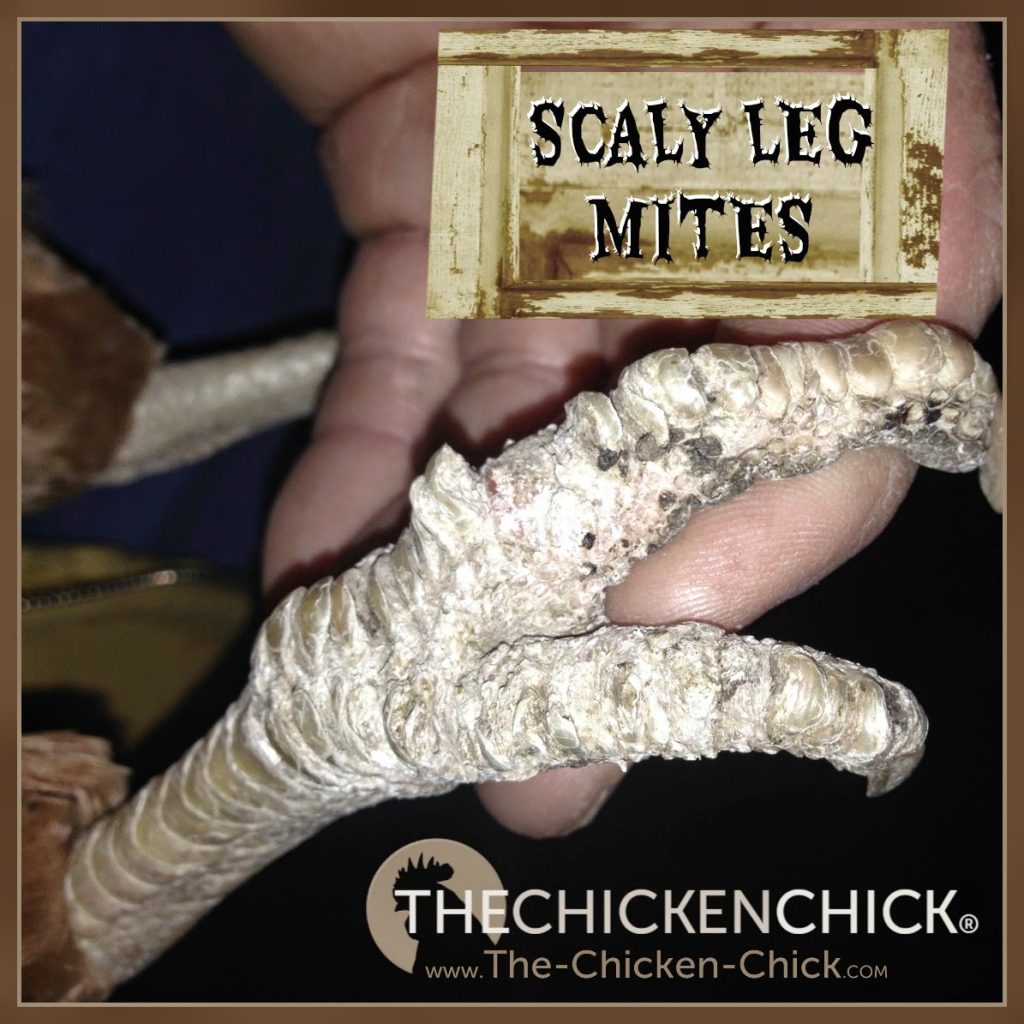
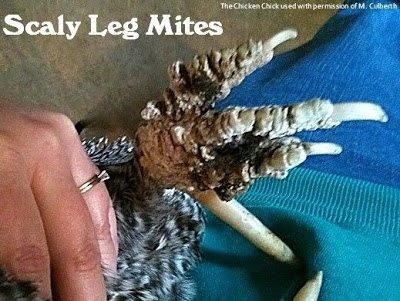
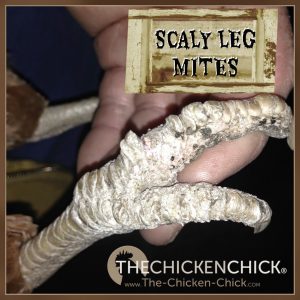
Scaly leg mites (Knemidocoptes mutans) are microscopic insects that live underneath the scales on a chicken’s lower legs and feet. They dig tiny tunnels underneath the skin, eat the tissue and deposit crud in their wake. The result is thick, scabby, crusty-looking feet and legs. The longer the mites reside under the chicken’s leg scales, the more discomfort and damage they inflict; an unchecked infestation can result in pain, deformities, lameness and loss of toes. 
Scaly leg mites spread from bird to bird in a flock, therefore when one bird is infected, all should be treated. As always when external parasites are found in a flock, the coop should be thoroughly cleaned.
TREATMENT OPTIONS
OPTION 1: Soak, Oil, Vaseline
1) soak the feet and legs in warm water
2) dry with a towel, gently exfoliating any dead, loose scales.
3) dip feet and legs in oil, (linseed, mineral, olive, vegetable) which suffocates the mites.
4) wipe off linseed oil and slather affected area with petroleum jelly.
The petroleum jelly should be re-applied several times each week until the affected areas return to normal. It may take several months for mild to moderate cases to resolve.
OPTION 2: Sulfur & Vaseline
An alternate treatment option for scaly leg mites is to mix 2 tablespoons of sulfur powder with ½ cup petroleum jelly- applied daily for a minimum of two weeks.
OPTION 3: Ivermectin
In severe cases of scaly leg mite, oral or injectable forms of Ivermectin may be prescribed by a veterinarian. Per Dr. Julie Gauthier, DVM the dosage is 0.2 mg/kg per bird, repeated in ten days. Gail Damerow indicates an oral dosage of Ivermectin of 5-7 drops for bantam birds, 1/4 cc for larger birds in The Chicken Health Handbook. She also states that “since the withdrawal time is not known, Ivermectin should not be used on birds kept for meat or eggs.” I do not recommend this medication for backyard chickens. It is extremely easy to overdose and kill chickens with Ivermectin.
OPTION 4: Gasoline & A&D ointment (Obviously, do not use this method if the skin is cut, cracked, or lacerated.)
This method is recommended by Dr. Michael Darre, PhD, Poultry Extension Specialist for New England at the University of Connecticut. It is effective and works quickly. This is the method I would use on my chickens if necessary.
Day 1: DIP the affected legs in gasoline (the cheap gas, no need for hi-test). Don’t rub on or brush on, DIP the legs in it. Hold the legs out and allow them to dry. Slather legs with A&D ointment. The A&D softens the scales and promotes healing.
The gas gets up underneath the scales and kills the mites AND suffocates the nits. The nits are the biggest problem when trying to treat scaly leg mites with other treatment options. It can take weeks with other methods and often doesn’t kill all the nits, so the problem never goes away.
Day 2: Slather A&D ointment on the legs only- no gasoline on day 2.
Day 3: Repeat the same treatment as Day 1. Gas dip. Dry. A&D. That completes the course of treatment.
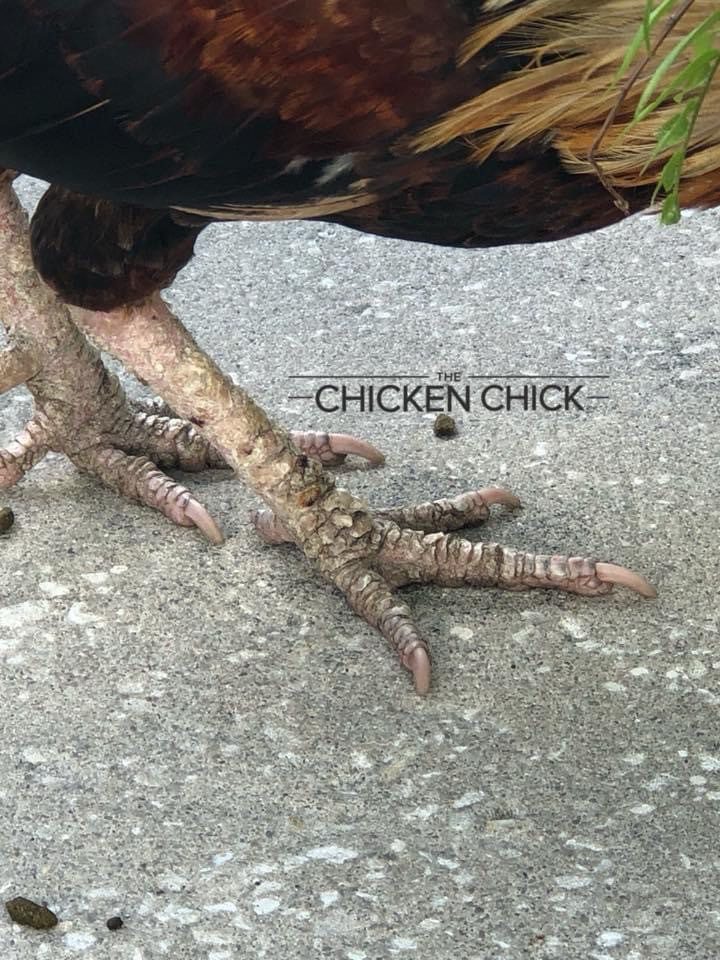
Scaly leg mites on a feral rooster in Key West.
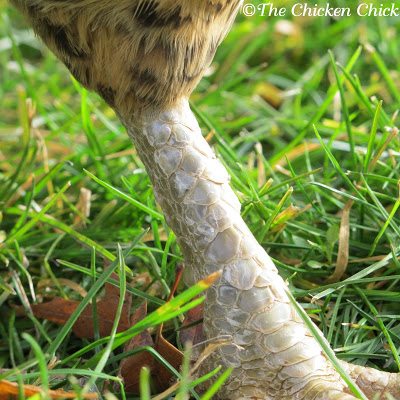
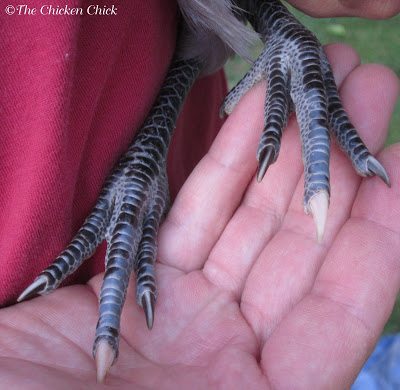
Healthy leg scales.
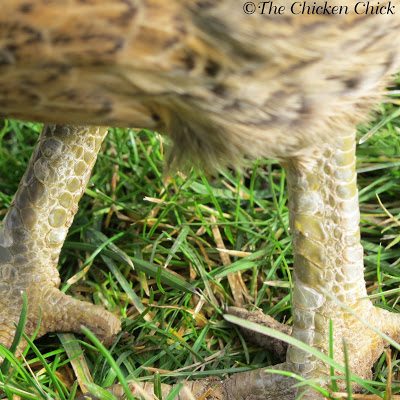
Healthy leg scales and toes.

Kathy Shea Mormino
Affectionately known internationally as The Chicken Chick®, Kathy Shea Mormino shares a fun-loving, informative style to raising backyard chickens. …Read on




shop my SPONSORS







Scaly leg mites (Knemidocoptes mutans) are microscopic insects that live underneath the scales on a chicken’s lower legs and feet. They dig tiny tunnels underneath the skin, eat the tissue and deposit crud in their wake. The result is thick, scabby, crusty-looking feet and legs. The longer the mites reside under the chicken’s leg scales, the more discomfort and damage they inflict; an unchecked infestation can result in pain, deformities, lameness and loss of toes.
Scaly leg mites spread from bird to bird in a flock, therefore when one bird is infected, all should be treated. As always when external parasites are found in a flock, the coop should be thoroughly cleaned.
TREATMENT OPTIONS
OPTION 1: Soak, Oil, Vaseline
1) soak the feet and legs in warm water
2) dry with a towel, gently exfoliating any dead, loose scales.
3) dip feet and legs in oil, (linseed, mineral, olive, vegetable) which suffocates the mites.
4) wipe off linseed oil and slather affected area with petroleum jelly.
The petroleum jelly should be re-applied several times each week until the affected areas return to normal. It may take several months for mild to moderate cases to resolve.
OPTION 2: Sulfur & Vaseline
An alternate treatment option for scaly leg mites is to mix 2 tablespoons of sulfur powder with ½ cup petroleum jelly- applied daily for a minimum of two weeks.
OPTION 3: Ivermectin
In severe cases of scaly leg mite, oral or injectable forms of Ivermectin may be prescribed by a veterinarian. Per Dr. Julie Gauthier, DVM the dosage is 0.2 mg/kg per bird, repeated in ten days. Gail Damerow indicates an oral dosage of Ivermectin of 5-7 drops for bantam birds, 1/4 cc for larger birds in The Chicken Health Handbook. She also states that “since the withdrawal time is not known, Ivermectin should not be used on birds kept for meat or eggs.” I do not recommend this medication for backyard chickens. It is extremely easy to overdose and kill chickens with Ivermectin.
OPTION 4: Gasoline & A&D ointment (Obviously, do not use this method if the skin is cut, cracked, or lacerated.)
This method is recommended by Dr. Michael Darre, PhD, Poultry Extension Specialist for New England at the University of Connecticut. It is effective and works quickly. This is the method I would use on my chickens if necessary.
Day 1: DIP the affected legs in gasoline (the cheap gas, no need for hi-test). Don’t rub on or brush on, DIP the legs in it. Hold the legs out and allow them to dry. Slather legs with A&D ointment. The A&D softens the scales and promotes healing.
The gas gets up underneath the scales and kills the mites AND suffocates the nits. The nits are the biggest problem when trying to treat scaly leg mites with other treatment options. It can take weeks with other methods and often doesn’t kill all the nits, so the problem never goes away.
Day 2: Slather A&D ointment on the legs only- no gasoline on day 2.
Day 3: Repeat the same treatment as Day 1. Gas dip. Dry. A&D. That completes the course of treatment.
Scaly leg mites on a feral rooster in Key West.
Healthy leg scales.
Healthy leg scales and toes.









What harm will the gasoline do if The scaly leg mites have caused too much damage to the chicken’s leg? How do I know if it is safe to use gasoline?
Don’t use it on broken skin.
Believe it or not, the gasoline soak worked miracles on my flock. Some were pretty severe and in just one round of treatment it’s gone. We couldn’t find the A&D so we used Vaseline. Just amazing results!!!
What is the quickest way to rid chickens ( not free range) of lice and mites ?
I use Elector PSP as discussed here: https://the-chicken-chick.com/poultry-lice-and-mites-identification/
What is A&D ointment
It’s a petroleum jelly type ointment for moisturizing.
How do you keep your chicken places so clean and perfect.They are beautiful and I love your articles.