
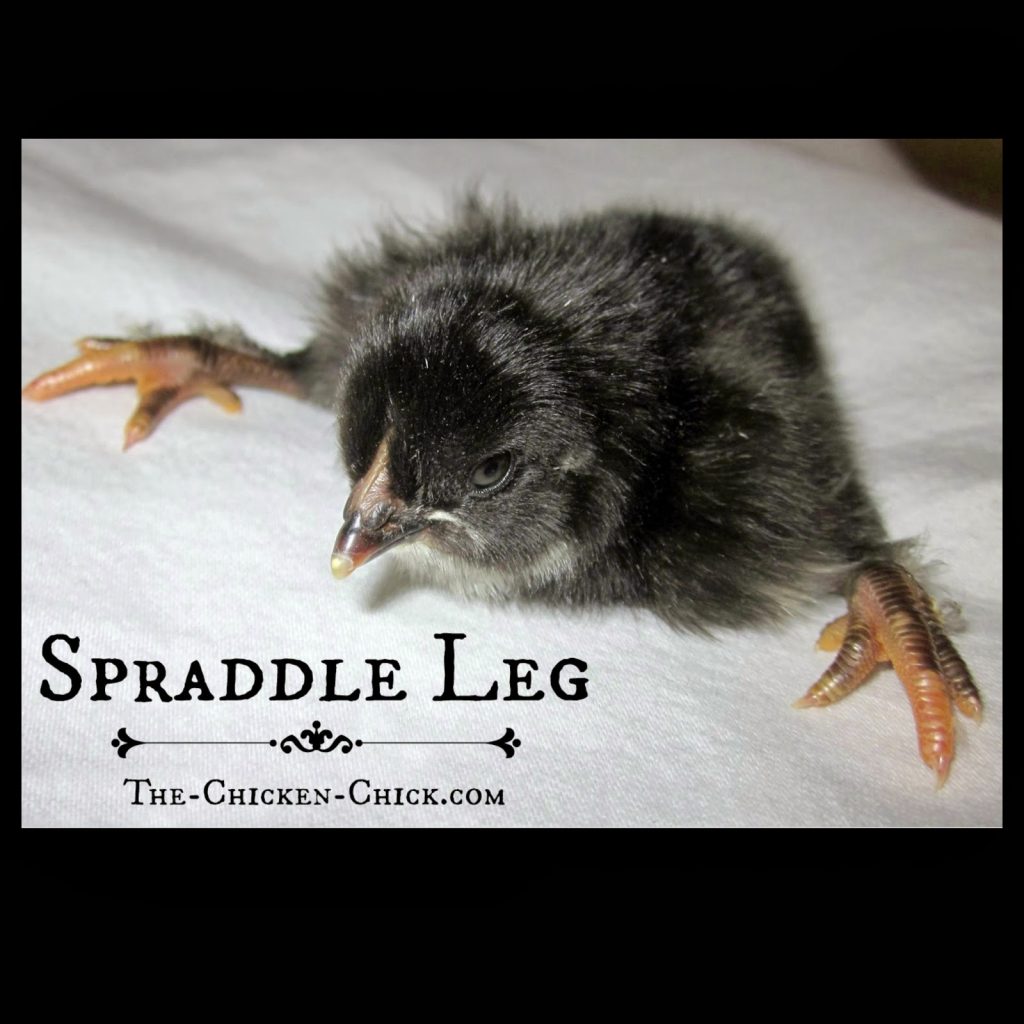
WHAT IS SPRADDLE LEG?
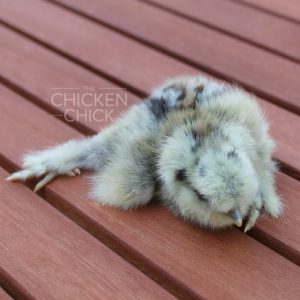
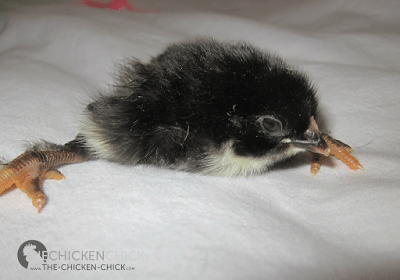
Spraddle leg, also known as 'splay leg,' is a deformity of the legs, characterized by feet pointing to the side, instead of forward, making walking difficult, if not impossible. It can be permanent if left uncorrected.
CAUSES
One cause of spraddle leg is slick floors that result in chicks losing their footing. The legs twist out from the hip and remain in that position unless corrected.
Other causes are:
- temperature fluxuations during incubation
- a difficult hatch that makes legs weak
- leg or foot injury
- brooder overcrowding
- a vitamin deficiency
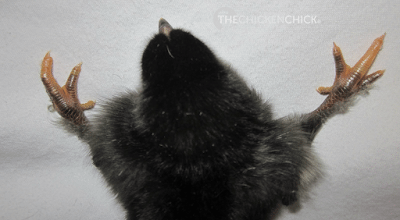
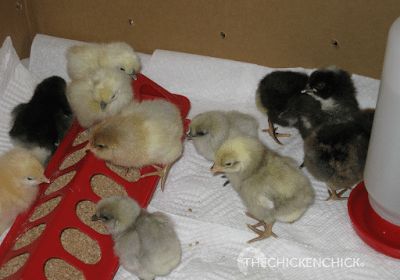
Providing traction for tiny feet is the best way to avoid spraddle leg (in cases where it can be avoided). Chicks should not walk directly on dry newspaper. Safer options are paper towels or rubber shelf liner covering newspaper.
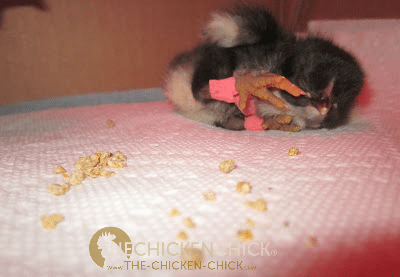
Valentina (hatched the day after Valentine's Day) had been abandoned while incubating under a hen. The egg was not warm when I found it. Hoping for the best, I put it in my incubator right away, knowing it was close to hatch day. The chick had a difficult time freeing itself from the shell and required assistance hatching. The leg deformity was immediately obvious. Inconsistent temperatures during incubation combined with the difficulties hatching were clearly the cause of her spraddle legs. She couldn't move from this position.
TREATMENT
The younger a chick is when treated, the better chance of preserving normal leg function. Untreated, a chick can die from inability to reach food and water without assistance. A chick can learn to push up, stand and walk correctly within less than a week, often much sooner if treated.
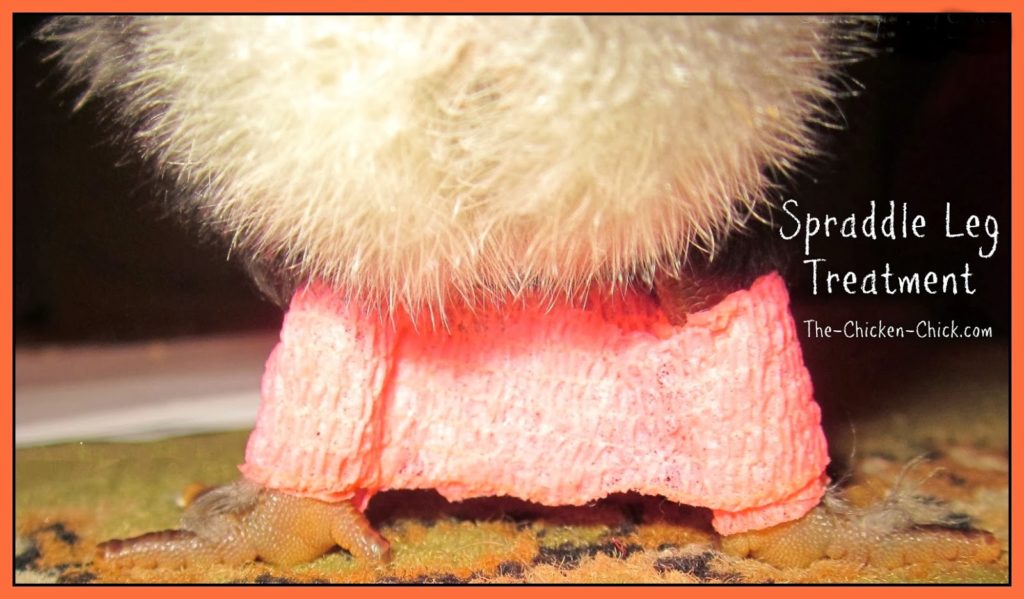
The legs must be restricted, braced or 'hobbled,' to provide stability and allow the chick's bones and muscles to grow and strengthen in the correct position.
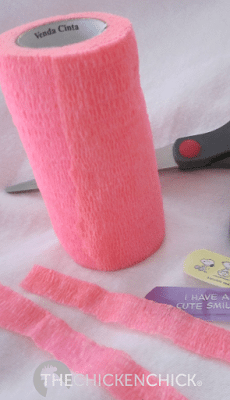
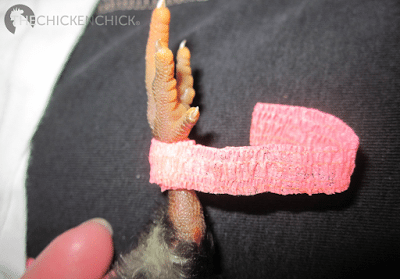
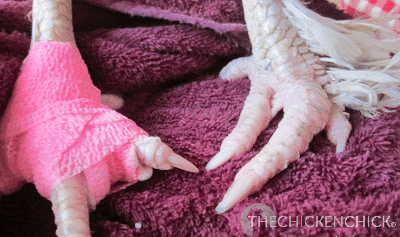
Any number of materials can be used for a brace, from bandaids to rubber bands, yarn to tape. My preference is VetWrap. It's easy to use, sticks to itself, stays securely in place, doesn't restrict circulation, won't damage the skin or leg feathers, is easy to remove and has just enough stretch to allow the chick to practice walking..jpg)
I wrap two little pieces of VetWrap around each leg just below the knee joint, being careful not to wrap too tightly. Since it sticks to itself, no tape is required. I find that these anchors make it easier to change the brace.
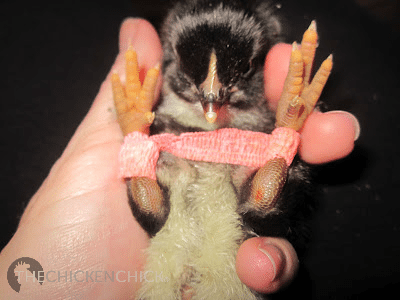
Next, I cut a long piece (approx 6-7") to bind the legs together. The legs should be positioned underneath the chick, slightly wider than a normal stance and should allow a slight amount of play in between the legs for the chick to move a little bit. The brace should be removed once daily to assess the progress and re-adjust as needed. It's important to ensure that the portion touching the legs does not restrict blood-flow. If there are indentations on the chick's legs, the brace is too tight. As the chick's legs strengthen, gradually allow for more slack between the legs until it is clear that support is no longer needed.
![]() |
| This wrap job is not ideal, but the photo was too funny not to share."Police! Hands up!" |

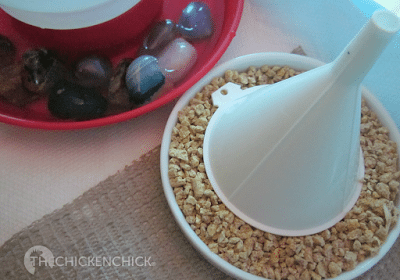
Chicks being rehabilitated must be supervised near water as they can drown. They will require assistance drinking at first. I put stones in the water as a safety measure. (The funnel just dissuades chicks from standing in the dish, until they learn to knock it over, of course.)
PHYSICAL THERAPY
Brief physical therapy sessions help build leg muscles and balance. Support the body and let the chick push up to get their balance. As it finds its balance, gradually reduce the amount of assistance provided until it can stand independently. One minute sessions, 6-8 times throughout the first day are very important.
This is a video of Valentina at the end of the first day of treatment.
![]() |
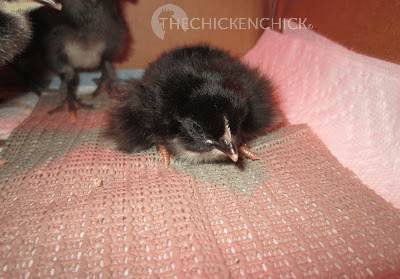
| Shelf liner assists in gripping to stand |
![]() |
| Standing is tricky at first. Remarkably, within 4 hours, Valentina was able to stand and walk. |
Here is a video update on Valentina's progress just 24 hours after the treatment.
Curled Toes
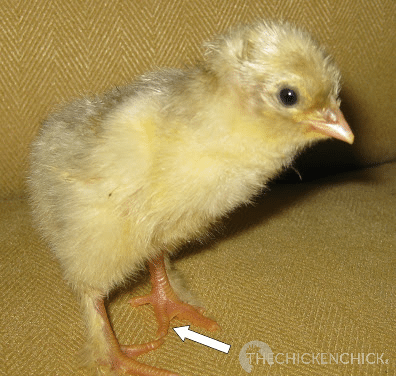
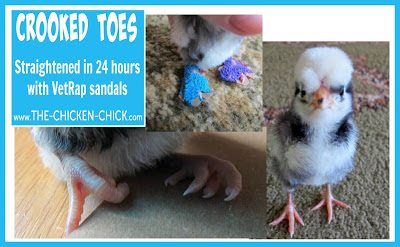
Most causes of spraddle leg mentioned above can also cause curled toes. According to Gail Damerow in The Chicken Encyclopedia, curled toes can also be caused when newly hatched chicks have too much room in the incubator; in trying to get up and about before their frail bones are ready for the action, they can bend them. Curled toes do not result in debilitation as spraddle leg can, but they are easily corrected.
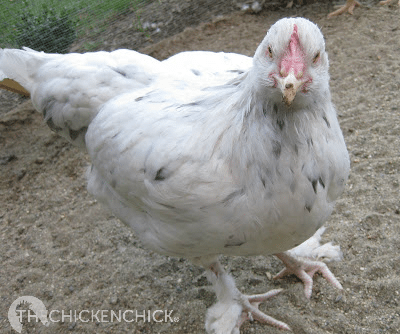
| Windy, my Blue Splash Marans, hatched under fluxuating incubator conditions due to a power outtage. |
![]() |
| Windy did not have her toes corrected as I was unaware of the treatment at the time. The crooked toes do not pose a problem for her. Poor Windy needed bumblefoot surgery but at least she got a pedi out of the deal. |
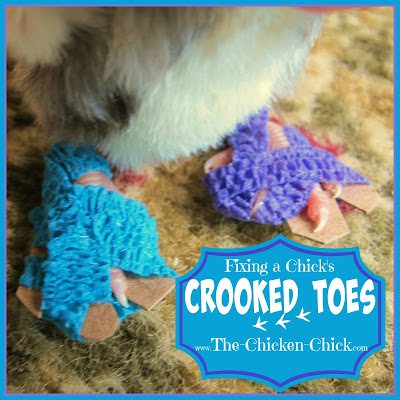
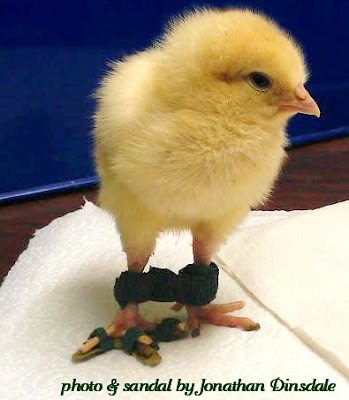
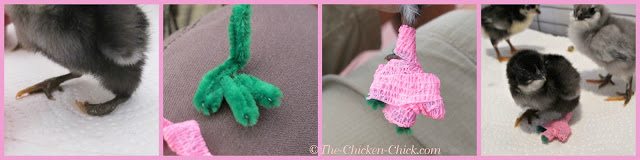
To straighten curled toes: Create a chick sandal by using thin cardboard (just heavier than oak tag paper) and trace around the foot (either mitten-style or glove-style as shown below). Cut wooden skewers, coffee stirrers or pipe cleaners (being careful to protect against sharp ends), to the length of the toe. With tiny strips of VetWrap, attach the skewers/pipe cleaners to the curled toes tightly enough that the splint will not move but loosely enough that circulation is not being restricted. Add the cardboard sandal to the bottom of the foot and Vetwrap it to the bottom.
The VetWrap provides traction to prevent slipping and is easier to work with than other options like tape. Generally, the younger the chick, the faster the response to treatment. The toes may remain straight after a day or two or may take up to a week or so before the bones have set in the corrrect position.
![]() |
| This is a brilliantly designed sandal by a Facebook fan, Jonathan Dinsdale. |
.jpg)
.jpg)
.jpg)
.jpg)

.jpg)
.jpg)
.jpg)


Wow! Amazing difference! I show my youngest son (7) and he thinks it's "cool" that you helped out the baby chick!
ReplyDeleteIf a 7 year old thinks it's cool, then I know I've done my job. ;)
DeleteThank you.
Absolutely amazing, wonderful and thank you soooo much for posting this. I am getting my first chicks ever in April and am so afraid of all the things that CAN go wrong. What a great instruction this is. Saving this!
ReplyDeleteMy pleasure, I'm glad it helps. Please feel free to follow my blog in order to get the newest posts directly to your inbox or newsfeed!
DeleteHappy to help with any questions you may have. You're going to LOVE being a chicken-keeper!
yes, i too am amazed at all the things i did'nt even know,or think about when i got my first chicks. it has been a learn as we go process,and if i had to do it all again,i would read up alot more than i did !!!they are a joy to have though....and you have to be patient.
DeleteVery good demonstration! Thanks for sharing. Is that a black copper marans chick by any chance? I have a few BC marans hens this year but am having difficulty getting their eggs to hatch. My other breeds hatch fine, but my BCM's need assistance hatching.
ReplyDeleteThank you! That is a Black Copper Marans chick! I wonder why your BCM egglets are giving you trouble? This one did pip on the wrong end and needed help out but otherwise, my hatches have gone smoothly with them. Curious.
DeleteThanks for stopping in today!
I have a hen "Wooble" who was treated unsuccessfully when a chick, she walks with a hop,skip,limp. If she has had a busy day she has difficulty and needs getting into coop at night. She was given to me and is an awesome pet. Wish there was a way to fix her now, she is about 1 year old.
ReplyDeleteThat's unfortunate, cejay, because once the bones have hardened and the muscles adapted to the deformity, there is nothing that can be done to fix it. :(
ReplyDeleteI've had to do that twice in about 15 years- worked wonders both times, by the next day I would have to really look close to see which chick had the hobbles on!
ReplyDeleteI must say, it is astonishing how quickly they respond to this simple correction. Tough little cookies, they are!
DeleteThis is a great blog (and all the other ones). I've never had a chick have this before but it's useful for the future just in case.
ReplyDeleteThanks Chrissy!
DeleteThank you for actually showing how to do that! I haven't seen it, but only heard about how to fix it! How long do you leave it on there and how will you know when to remove it?
ReplyDeleteGreat questions, Tweetysvoice. While this chick was walking fine within 36 hours, I'm going to leave the brace on her for at least a week. I want her leg bones and muscles to get set in that position and don't want to risk an injury that could cause it to recur. She should be good in less time but I'm conservative like that. :)
DeleteThanks for letting me know your real name on FB Chrissy!
DeleteI just started following your blog and love it! I have got to make me some PVC feeders love the idea!
ReplyDeleteThanks Meghan! I'm looking forward to seeing the photos! :)
Deletemy husband saw those feeders(pvc),and he made one for our girls. it's so much nicer than feeding constantly every day. but we made sure that it has a cap on top,and under the hutch so no moisture gets in there....love it !
Deletebest feeder we've evr had !
I just signed up to follow your blog!! I have been reading it, but now I won't have to go find them - they will find ME!!
ReplyDeleteThanks for joining me, merrymelinda! I hope you have a chance to poke around and find some things that interest you. Nice to have you with me. :)
DeleteI've had one successful fix using the bracing method but just the other day I had one that had a difficult hatch & this poor little chick not only had spraddle leg but both legs started turning up behind its little head. It was a horrible thing so I had to put the poor little thing down :(
ReplyDeleteAw, poor little one. Sorry to hear about it, Alison. :(
DeleteWonderful information! We would love to win a sticker and subscribed, too! Thanks!
ReplyDeleteThanks sisqsis! I'm glad you enjoyed it. You're entered to win a decal. I have lots of giveaways and other great information on my Facebook page, I'm happy you've joined us for them!
DeleteI am knew to your Blog......looking forward to following you and learning as I go !!
ReplyDeleteHi Loana! Thanks for coming over from Facebook! Please let me know if you have any questions I can help with. I'm happy to know you've joined me!
DeleteI am a new follower of your blog. Last summer we had our first egg hatch. The poor lil peep had spraddleleg. this is similar to what we did except we used band-aids.
ReplyDeleteHi and thanks for joining me! I think that bandaids are the most commonly used material for hobbling. I just didn't like the idea of the sticky stuff on their little legs, particularly when many of them have feathered shanks.
DeleteIn considering all the options for provide maximum comfort, circulation and the little bit of flexibility I was looking for, VetWrap was the obvious choice for me. I'm sure they all work fine.
SuziQ's first buddy was a grown up splay legged...Lots of them in the factory farm chicken houses...
ReplyDeleteYou, Suzi Wallace Fire, are a godsend to the chicken world. Your reward will be great in Heaven (of course, it'll be in the coop section up there, but Heaven nonetheless). ;)
DeleteThis has yet to happen to any of our chicks. I now feel prepared when and if it does. I use the rubbery shelf liner in the brooder for the first couple days. It is cheap and can be laundered on delicate, hang to dry. Great post. Thanks.
ReplyDeleteHi Mama C and thank you! I hope you never need this information but if you do, now you know there's no magic trick to it.
DeleteThanks for stopping in tonight!
Thanks for this post! Luckily this has not happened to one of my chicks or I would be real unprepared! I have never heard of spraddle leg before and now with 24 babies coming next month I need to know what to do if this happens to one of my chicks. We usually just put hay out in our brooder but I guess I need to buy some shelf liner too.
ReplyDeleteHi Makenna! Thanks for coming over from Facebook! You sound good and prepared for your double dozen babies. I can't wait to see pictures of them!!
DeleteVery helpful information! Love the VetWrap idea! I feel so bad for little babies with spraddle leg / Splay Leg! Knowledge is power when dealing with handicapped babies!
ReplyDeleteThanks, Sooey. Be prepared, that's what I say!
DeleteI am so glad she is getting better!!! I love the idea about the funnel in the food too....my little chickies loved to stand in their feed dish!
ReplyDeleteMolli, it doesn't take long for them to learn to knock it over. LOL But it works for a few days and I thought it would make life a little easier for Hop-along. :)
DeleteI am a new follower!
ReplyDeleteThank-you SO much for posting this! A while back a hatched a bunch of button quail chicks, and this happened to one. It would have been WAY too small to brace, (they're about the size of the tip of your thumb) but at least now I know how to save them!
Holy tiny bird, Kaylin! You must share pics on FB with me!
DeleteI am a new follower! Love this post and I hope you don't mind if I share this in the future, I have so many friends ask me how to fix spraddle leg and here is a great step by step for anyone and everyone to learn!
ReplyDeleteJessy Phelps
Hi Jessy and thanks for joining me! By all means, please do share this with anyone you think could possibly need to know it one day.
DeleteI find this post very interesting! Thank you for posting all of this info! Hopefully it's not something that I will use, but it never hurts to have info available for "if the time comes." Happy hatching!
ReplyDeleteThank you, Patricia! Never a dull moment with chickens!!
DeleteThank you so much for this timely blog! One of my 3 week old Silkie chicks developed splay leg seemingly overnight. She was perfect until yesterday morning when she was completely splayed. They are still on rubberized shelf mats in the brooder and being fed Purina Chick Starter...I'm at a loss as to why she is suddenly splayed. I just finished putting a velcro brace on her and she is unhappily lying in a corner with a couple of her sibs. I'll be taking her to work with me tomorrow to make sure that she is eating and drinking. Any suggestions? Thank you SO MUCH!!!
ReplyDeleteWow, what timing! They do not care for the brace initially and as you can see from the photos above, they find standing at first a challenge.
DeleteJust be sure the brace isn't holding the legs too close together so that she can't get her feet under herself. The legs should be just a little wider than directly underneath them. It helps to assist them in the first few hours with standing. They progress remarkably quickly. Start with 45 second therapy sessions six times a day (or as often as you are able without wearing her out) and by the end of the day, she should be able to stand independently (if not sooner).
I highly recommend the VetWrap as a brace material due to the stretch factor. Please let me know how she does!
Thank you so much for the encouragement! I'm not sure why I typed "velcro" when I meant that I used a VETWRAP brace on her...too late in the evening, I guess :)
ReplyDeleteShe was looking pretty defeated this morning, so I widened the brace a bit. She sat up better, kinda on her hocks, but quickly fell asleep. I will definitely keep her in therapy for as long as she needs it. Have you heard of this happening in older (3 wk) chicks? I can't imagine why this would happen all of a sudden...
Spraddle leg can happen in older chickens, yes. It may be due to some weakness in the legs or an injury of some sort.
DeleteI invite you to share a photo of the brace with me on my Facebook page so I can get a better idea of why she may be having a tough time with it. Is the VetWrap below here 'knee?' You can find me at Egg Carton Labels by ADozenGirlz if you're not already a fan on the page. Keep me posted!
Thank you for the information! If only I would have found it last year I may have been able to save one little chick that was spraddle legged! Will keep this page bookmarked so I can find it easier! Thanks again!
ReplyDeleteOh gosh, I'm sorry about your little one. :(
DeleteI'm happy you now know how easy it is to fix. They are remarkably quick healers!
Hi Kathy!
ReplyDeleteI'm sorry that I haven't shared any pix on your fb page...I actually gave up fb for lent, so the visuals will come later :)
After a week with the "brace" on, I took off the wrap and her left leg was fine, but her right leg stuck straight out from her side. I was so upset that I called my Avian vet and talked to him about it. He said that splinting is really all he would do, although he could run a series of xrays to determine if her leg could ever be normal. I decided to go for broke - I resplinted her leg, including the part above her hock since that seemed to be the problem point. She is unable to walk, so I have been bringing her to work with me to keep her eating/drinking/standing up. Every hour I make her stand for at least a minute, while I lightly support her. I'm giving it till next Wed (1 week) to see how it goes. Meanwhile she is my constant companion; purring in my lap while I work on my computer each day :) I will let you know how it goes!
Aww, poor girl! I'm impressed with your commitment and dedication to her therapy. I hope it works out for her. Please keep me posted.
DeleteSee ya after Easter on FB. ;)
Okay. I must have "sucker" plastered all over my face. I took off the extreme splints a few days ago and her right leg had not changed at all - still angle out to the side and useless. I took her in for xrays and the vet said that her legs are normal, just that the one is spraddled. She agreed that the chickie is not in any pain and seemed to be very happy with all of the attention! So...euthanize or a life of accomodating for her lameness? Guess which I chose? I have modified one of my parrot's travel cages to be her home. Her stuffed pig is in with her to support her little body and give her something to cuddle with. Her food and water is right within reach and the slats in the carrier allows her to socialize with her hatchmates. And, of course, she spends ALOT of time just snoozing in my lap either at work or while I am working on the 'puter at home. Crazy? Probably. Happy? Both of us seem to be. :)
ReplyDeleteHmmm. Any reason not to leave the splint on her so she can at least stand up and walk by herself? I would try that in hopes that she may be able to walk independently one day.
DeleteDid the vet have any hope of that for her?
When I spoke with the vet about doing that she said that it wouldn't hurt, but at her age (6 weeks) it was highly unlikely that her leg would ever be normal. I just came in from letting her out on the grass with her hatchmates in their pen and I've decided to re-splint her. She was never able to walk with the splint, but she was able to stand...so it is definitely worth doing. I thought that she might be more mobile without the vetwrap, but that is just not the case. I also saw on BYC where someone had fashioned a bandaid "shoe" for their chick, so I'm going to try something like that as well. She seems to need something to give her a bit more traction to keep that leg under her...
ReplyDeleteThank you so much for your suggestion, Kathy! ALL are welcome...I'm so brand new to all of this and I want the very best for my little girl!
I would try the VetWrap for the chick boots too, they will give her just enough traction to not slip on the floor as she might with bandaids. Try a tiny foot-print sized piece of lightweight cardboard underneath the VetWrap and see how that works for her. The product is much more forgiving than bandaids in terms of not sticking to legs and being less constricting. Let me know how it works out fo ryou!
DeleteSadly, my little Silkie chick passed away on Saturday. It was very fast - I had been suspecting that something was going on with her neurologically since she had moments of posturing, but this was a total surprise. God's mercy at work, although it was a tough, tough day...
ReplyDeleteI am very sorry. You did all you could. (hugs)
DeleteI have a Button Quail and she has spraddle leg in one leg. I have tried bandaid (cut), rubber bands and yarn. With the band aid, she rolled over and couldn't get up. The yarn kept slippin up her legs, so I put tape over the top, but still, legs pull apart. I sent my husband out to get this tape at the drug store. I hope it works! Martha
ReplyDeleteMartha, how did the VetWrap work out for you?
DeleteI have a chick that hatched out late last night and could still not stand by late morning today. Her legs look like spraddle, but they are pulled way up by her head instead of out to the sides; like someone folded her in half. I made some hobbles for her, so we will see if it works! thanks so much for the information! -Samantha
ReplyDeleteAny luck with her, Samantha?
DeleteWe have a lil Roo (Named The Law Man)that is going to be 8 weeks old this Saturday (April 21st) We had to help him out as he had splay leg after hatching. He done well with treatment and his legs straightened out with no problems. My husband and I just recently found that he has 2 curled toes. We had NO clue what happened to cause it until I just read your post/contest. Is it too late to try and straighten his toes at 8 weeks old? When we tried to look him over it seemed as tho it hurt him when we were looking over his toes (unless he just didnt want us to mess with them ?)Any help would be greatly appreciated.
ReplyDeleteHi Deleith!
DeleteIt's probably too late to straighten his toes. You could try but if he objects, I'd just leave them alone. My hen, Windy, has no problems with hers at all.
Congratulations Deleith! You have won the 'got eggs?' tee shirt today! Please contact me with your shirt size and mailing address at: service@CustomEggCartonLabels.com
DeleteThank you so much Kathy I appreciate your help! I think we will leave The Law Man be, he is doing fine with scratching and foraging etc. Now that we know Curled Toes goes along with Splay leg we will for sure be on our toes with the little ones as we get them! Also a BIG thank you for the T-Shirt..I have been wanting one WOOO HOOO Im excited!
DeleteI sure wish I would have seen this a few weeks ago. We had a hen hatch a clutch and leave one chick behind. Spraddle leg was the reason why. My daughter decided to try to save her and did make her a splint, but if we would have seen this, we could have done a much better job. Maybe we would have had better results too. Sadly our little "Hope" did not make it more than a couple of days. :( Thanks for the info though, now next time this happens we will be better informed on what to do.
ReplyDeleteAw, that's a bummer Lisa. She may have had other things wrong with her though as spraddle leg does not cause death but some of the hatching issues that resulted in these outward deformities probably caused internal deformities as well. Sorry to hear it and glad to know you feel better prepared now.
DeleteCheers.
I have a bantam chick that has a toe that is turned under...would this work? I feel bad because he/she gets around okay but I can't imagine it will be easier as he/she gets older. I am worried about the ability to scratch!
ReplyDeleteThat's what curled toe is and the instructions above for the chicken sandal is what you want to make. The sooner it is put in place, the better.
DeleteMy crooked toe hen does fine even with the deformity. She gets around and scratches with no problems at all but I'm sure it would be easier for her to roost with straight toes.
What is the window of opportunity to correct crooked toes? (does it have to be done within the first week or so?) Sorry I didn't find your blog when my girls were tiny...!
ReplyDeleteI'm not sure what the outside limit is, Jolie, but the sooner the better. The purpose of hobbling the legs and toes is that setting them in the proper position allows the soft bones of a new chick to harden in the correct location. It should only take a day or two to correct the deformity in a newly hatched chick, so I would imagine it's safe to assume that the bones harden within the first week or so.
DeleteThanks. Mine are 9 weeks. Did not know this was a fixable condition, but will file this nugget away for the future!
DeleteI didn't know it was either a couple years ago. One of my Blue Splash Marans has awfully crooked toes on one foot and I did notice it but had no idea it could be treated. I even brought it to the attention of the owner of the hatchery and she didn't mention anything about fixing it. Go figure.
Deletetried this on one of our chicks a few weeks back and it worked fine, thank you.
ReplyDeletehoward jett
Thank you! Thank you! Thank you! Now I know how to help my chicks!
ReplyDeleteI learn so much...thank you KAthy!!
ReplyDeleteEGGSELLENT JOB!! I have only been doing this for 60 YEARS,, and glad you are here to help out!!really stuff I never thought of, or had! When things are going and I am hatching 600 chicks every 21 (18) days, you dont want to know what happens to spraddle legs? I think heredity plays a factor too as some breeds in the same incubator, same feed for breeders,
ReplyDeleteetc.,, are prone to this!!
Kathy, I just LOVE your blog. So much great information. Thanks for doing what you do! One day I'll figure out how to comment with an ID! For now, Anonymous Jan!
ReplyDeleteTHANK YOU! I had a chick with both splayed leg and slightly curled toes. I knew how to treat the splayed leg, and successfully did so, but never knew that the toes could be straightened. Llewellyn grew into a fine Black Austrolorp, but always had the curved toes that made her hobble a bit. Sadly, at about 6 months she and 4 other pullets out of my 7 girls were carried off by a predator. (We think fox or coyote) At least in the future I will be prepared to deal with the toe issue if it should come up again!
ReplyDeleteSo much to learn and you are a great teacher.
ReplyDeleteThank you Nancy. ♥ I hope it helps!
ReplyDeleteHey Kathy, I have a Red Sagitta 3 week old chick. This is my First of this breed. They are a extra large breed that is noted to grow fast. Not sure if that is why but this chick left leg at knee joint has the foot out to the side at a 90 degree angle. I tried this taping each leg and taping a brace between but the foot is still out to the side . Should I do a splint higher any thoughts. Would be very thsnkful
ReplyDeletehow long should i keep it on the chick all he does is hop on one leg and the other is out to the side
ReplyDeleteI had seen this post a while back and I am glad I did. I went to pick up some Maran chicks today and the lady gave me an extra because it had "bad legs" It looks like one toe is bent the wrong way and that leg is out to the side. The other leg is doing good and it just hops around. I brought it home and now have it braced. I tried the shoe but it didn't stay on. I will have to make another and see if I can get it to stay on. Hope it works!
ReplyDeleteI hope it works too, Christina! Keep me posted.
ReplyDeleteHello, i think that i saw you visited my blog thus
ReplyDeletei came to “return the favor”.I'm attempting to find things to enhance my site!I suppose its ok to use a few of your ideas!!
Also visit my website: what is link building
What is the material of the sandal made out of for helping the curled toes? I used a guitar pick to help one of my chicks two years ago.
ReplyDeleteWhat material was the sandal made out of to help with the curled toes? I had used a guitar pick for one of my chicks two years ago.
ReplyDeleteYou must be an AMAZING woman! I am brand new to chicken raising, I have 6, 6 week old cuties and I am learning so much from you. Thank you for taking the time from your busy day to give all of this information. Wish Me Luck!
ReplyDeleteKathy, I can't thank you enough for your help. I corrected 4 little sets of chick legs and one foot using your pink bandage information (and photos, invaluable)! You are a life saver, literally.
ReplyDeleteI don't know why I had so many problems with my day old chicks this time around, I've never experienced it even once before this. Is it possible it is a gene from some of our new hens. It seemed to be confined to the Buff Orington cross chicks.
Thanks again!
It could be genetic, so you may not wish to use that pair going forward.
ReplyDeleteAwesome. My first hatchling has a curled foot. Now i can fix it. Thank you!
ReplyDeleteI got a chick Saturday with this problem. Went to the info on your blog, followed the directions and within 24 hours the chick was walking with no problems. Thanks so much for sharing this with us chicken lovers.
ReplyDeleteThanks again Kathy!! I am so glad I read this when you posted it last year! I had a whole clutch of eggs a hen got off of and when I found them they were all cold :( We put them in the bator and 2 hatched yesterday first one was out and moving a bit when we got up yesterday morning (it's peeping woke me up) and the second pipped shortly after, it stayed pipped till about 1am this morning and when it came out of the shell completely it still had some yolk attached and I was afraid it would not make it. I put it in the brooder with the other chick and it has since absorbed the rest and it looks fine. Now I see that it has one splayed leg and a toe curled on the other foot. Off to make a brace and a sandal. I have kept vetwrap on hand since working for a vet in high school. I will update you on how it goes.
ReplyDeleteI'm sure she'll do fine, Amanda! Do keep me posted!
ReplyDeleteHelp . My darling 3 week old silky has developed straddle and also curled toe. She is weak but eating and drinking: very upset because the sandal although keeping her feet straight has her leg curled inwards. She can hardly walk and just lies there flapping around. I literally feed her and give her water by hand. She seems ok and keeps staying with us but I am so worried. Can I send you an image?
ReplyDeleteThanks for the great, practical advice. I just noticed today that one of my 2 wk old EE chicks has a bit of curl to her inner toes. If it doesn't affect her walking (and we're not breeding), I'm wondering if there's any harm in just letting her be - like your Windy.
ReplyDeleteIf I had known that Windy's toes were going to get much worse, I would have fixed the minor turn in her toe when she was a chick. I'd do it, Darci.
ReplyDeleteI'm going to try it in that case. Thanks so much.
ReplyDeleteI have a chicken that was left under a flower pot (for about 3 day, as it was a small child that had come for a visit and left 3 days prior to
ReplyDeletefinding her), she was very weak and could barely hold herself up. I nursed her back to health by hand feeding and dripping water for her to drink. Three weeks have gone by and she is alert and eats well, but her legs are not working right. She takes very high steps and flaps her wings to get around. Is this sprattle leg and do I treat it the same as the little chick in the above pictures? She is out of the dark, health wise. Her comb is standing up now and her eyes are clear and sharp. She manages to protect herself from the other chickens and can get her own food even when competing with the rest of the flock. I have housed her in a little coop (capacity for 9 chicken) by herself and she manages to get on the low perch but not the high one. Oh, and she is a two year old Barred Rock. Please help me if you can.
Wow, even by today the curl had gotten worse. I've got her splinted and wrapped up now, and can't wait to see how it works. She's getting around fine, but disturbed by the sandals, of course, so I feel for her. The others are picking at the sandals, too, but her toes are covered so hoping they can stay together. I'm keeping an eye on her. Do you think the others will adjust and leave her feet alone?
ReplyDeleteYou're going to need to play it by ear since she is older.
ReplyDeleteIt doesn't sound like spraddle leg to me, Lisa. I would definitely consult a vet to see if there is something that can be done about her legs. :(
ReplyDeleteSo. . . thanks to your blog, I fixed my hatchlings curl toe at two days. Then she developed spraddle leg and it seemed to be corrected. Now she has the problem with her achilles tendon. I just don't know if i should give up on her. She is almost a month old now. She can get around and she is self sufficient with food and water, but she is always flailing around. I just cant get her legs to heal up right. I hate the idea of her being crippled forever.
ReplyDeletewow this is so brilliant, mine is on her first day . culed and has spraddled legs, not i tied her legs but did not know how to do the tie for the toes... i hope you do provide us with a video...
ReplyDeletethanks alot you blog has helped me alot
Hoping for some help, I have an 11 week old chick, she has the toe almost exactly like your windy does. Is this too old of an age to try and splint it for correction? She walks fine, does not seem to cause a problem, she is eating and drinking normally. I just want to give her the best care I can. Thanks so much!
ReplyDeleteThis is such a huge help, thank you! I have a 5 day old chick with severely curled toes and spradled legs. I did a band aid brace with her legs but am going to switch to vet tape.
ReplyDeleteI'm worried about her toes though because they are so tightly curled that I'm afraid to force them straight for banding. At 5 days old are they still flexible enough that I should be ok with forcing them straight? I don't want to hurt her.
Mine is a cross between Blue Splash Marans and White Leghorn.
I also read on the Merck vet manual that this could be caused by a deficiency in riboflavin/B2.
I just brought home a 24hr old chick, not standing up. I wrapped its legs (as you showed) and now I'm wondering if there's a curl. It's not eating- it's drinking water and chirping and trying to move around. Should I take this as a good sign??
ReplyDeletethank you. I love the little sandal that is so cute but does its job. I had a chick with spraddled leg and I had no idea how to help it, sadly it persihed. But now I know what to do if it ever happens again. :)
ReplyDeleteThis is my go-to site for chicken care info. Thank you for sharing!
ReplyDeleteWhat an interesting article. I learned so much from it, thank you. I have a similar problem with a chick right now and it's the second time this has happened. The chick hatched perfectly normal and is about 4 weeks old. The other day, I noticed that it started to limp and not move as freely. Now it walks on it's elbow/knee joint but can get up on it's feet if it needs to run. If this is like the previous chick with this problem, eventually it will be unable to walk altogether. With the first chick, i kept it separate from the others and gave it physical therapy such as you described and eventually it got better. It is active, eats and appears to be perfectly healthy otherwise. Any ideas what it could be?
ReplyDeleteI have a chick with curled toes and spraddle leg and has a hard time walking and uses its wings to balance and move I have tried the vet rap around his legs to keep them together and it hasn't worked very well...I have not tried the sandles yet but I'm afraid he is to small he is two weeks old and still very small. help please
ReplyDeleteThankyou loads for this! It really helped. =)
ReplyDeleteTHANKS SO MUCH FOR THE INFO ON SPRADDLE LED I AM SURE IT WILL WORK
ReplyDeleteI have a 3 week old chick that seems to have splayed legs, they look bowed. I swear she didn't have them four days ago. The Band Aid doesn't seem to work where I need it too. The problem is that her "knees" bow out. She hated the Band Aid, and it didn't seem to help where she needed it.....Any suggestions. She is still walking, eating, and drinking, just sitting down more.
ReplyDeleteI had a baby chick born yesterday and her feet were curled. Thankfully, I read this article just last week and was able to make sandals for her. But I'm curious because even though she kinda hobbled before, with the sandals it seems harder for her to get around. She can't sleep without tipping over because she refuses to lay down unless I wrap her in a warm washcloth on her side for her naps. All the other chicks in her clutch are already eating and she won't. I have given her drops of food because I don't want her to get weak. Should I be really worried about her not keeping up with the others regarding eating or should I worry more about that in a day or two. She's still got the yoke to feed off of but I don't want her getting sick on top of having to wear the sandals. Also since she was less than 24 hrs when we put the sandals on her, how long does it take for her bones to firm up in the correct position. I'm going to be replacing the sandals each night because she hops in the food dish to try to sleep and gets them pretty dirty, so if they seem to be staying straight when I replace the sandal can I just leave it off or is there a chance they will curl again?
ReplyDeleteI know I have a million questions and I'm sorry. I'm just really worried about her and I am hoping I am doing this right.
Here's a pic of the sandals we put on her. Does it look ok for mobility?
She should be all set by now. It doesn't usually take more than 24 hours for a day old chick's toes to straighten out. When you take them off to change them, you'll be able to assess their status at that time.
ReplyDeleteOk so my chickens will be 20 weeks this weekend and I have a chicken that has just recently developed curled toes. Is it too late to do anything? He appears to be uncomfortable sitting a lot more than usual.
ReplyDeleteI have a 2 week old chick whos legs do not work. It keeps them straightened, it cannot walk or stand. Ive tried bending its legs and sitting it upright but it just falls over. It moves by flapping his wings and looks like its swimming. Any ideas on what it could be? Thank you!
ReplyDeleteGot a batch of 35 CornishX today and one has a splayed leg. I hobbled it with the vet wrap Thank you!) and had to isolate her from the others as they were trampling her and pecking at her. She is in her own cage with water, food and a light for warmth and is on a dresser in an unused room. We'll see. I've got my fingers crossed. I know that if she lives she will be meat in the freezer in several weeks, but I couldn't just let her be pecked or trampled to death. I've got real soft spot in my heart for all my critters! Thanks so much for the tip.
ReplyDeleteI don't know what it is, but if it can't eat or drink on its own because it cannot get to the food, you may have to make a difficult decision very soon. :(
ReplyDeleteIt's likely too late, Michelle, as their bones have already hardened at 20 weeks old.
ReplyDeleteThank you for all the work you put into sharing such wonderful info with us! I had a light Sussex hatch with spraddle leg. I'm trying your suggestions now. Thank you again and please keep sharing!
ReplyDelete